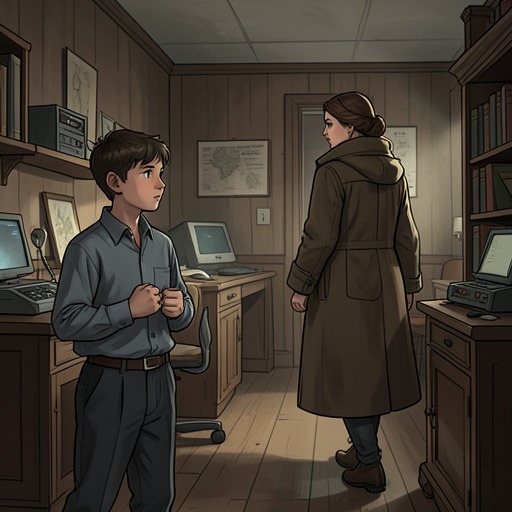
Zinaïda Alexandrovna Zasyekin
First LoveZinaïda Alexandrovna Zasyekin is the daughter of Princess Zasyekin and the object of Vladimir Petrovitch’s first love. Her significance shifts with his understanding of her: she first appears as a confident, teasing young woman, then as the beloved of his father, Piotr Vassilievitch, and finally as a woman whose death Vladimir learns of too late to see her again. Because the story is recalled by Vladimir, her inner life remains partly beyond the reader’s reach; her gestures and choices are filtered through the powerful impressions she leaves on him.
Identity and First Appearance
Vladimir has seen Zinaïda the previous evening in the garden before she appears in the doorway of her mother’s drawing-room. Princess Zasyekin introduces her as her daughter, calling her Zinotchka, and identifies Vladimir as the son of their neighbour. Zinaïda already recognizes him. She asks permission to call him Monsieur Voldemar, establishing an intimacy that is at once playful and slightly formal. Her mocking smile accompanies this first encounter, giving Vladimir the sense that she is aware of the effect she has on him.
The scene makes her self-possession part of her first impression. While Vladimir rises and stutters with excitement, Zinaïda controls the exchange: she recognizes him, proposes a name for him, and lets him accept it. The contrast between his visible nervousness and her composed teasing introduces a pattern that will shape his memory of her. She is not simply the object of his attention; in their earliest conversation, she actively sets its terms.
A Farewell and a Changing Image
When Vladimir comes to say goodbye before his family leaves, Zinaïda is no longer presented through the lively manner of their first meeting. Princess Zasyekin greets him, and Zinaïda comes in from the next room pale, dressed in black, with her hair loose. Without speaking at first, she takes Vladimir by the hand and draws him away. She tells him she heard his voice and came out at once, then asks whether it is so easy for him to leave them. Her address to him as a bad boy keeps the teasing intimacy of their earlier exchanges, but now it is bound to an actual separation.
Vladimir tells her that he has come to say goodbye, probably for ever, and that his family is going away. The scene gives her a direct response to his departure, but it does not explain everything she feels or why she draws him aside. That limit matters: Vladimir records the gestures and words that remain with him, while Zinaïda’s private thoughts are not independently narrated. The farewell therefore adds tenderness and urgency to the image of her without resolving its uncertainties.
The Secret Attachment to Piotr Vassilievitch
Vladimir later sees Zinaïda at an open window in a small wooden house, speaking with his father, Piotr Vassilievitch. He has been left waiting with the horses while his father turns into a nearby street; from forty paces away, Vladimir finds his father leaning over the windowsill and Zinaïda partly hidden inside the house. The unexpected sight holds him in place. He watches them and tries to listen, becoming a witness to a private relationship he had not understood.
His father appears to insist that Zinaïda separate from someone or something, while she refuses to agree. Vladimir remembers her serious, mournful expression and reads devotion, grief, love, and despair in it. She answers in brief words, lowers her eyes, and smiles without yielding. When Piotr Vassilievitch strikes her arm, she looks at him silently and kisses the place he struck; he then throws away the whip and rushes into the house, while she turns from the window. The brief exchange makes their attachment visible through conflict rather than explanation. It also alters Vladimir’s understanding of both his father and Zinaïda: the woman he had loved from a distance is bound to his father in a relationship marked, as he witnesses it, by affection, resistance, and unequal power.
Madame Dolsky and Her Death
Years later, Meidanov tells Vladimir that Zinaïda has married a man with property who is his colleague in Moscow. He gives Vladimir her address: she is staying at Hotel Demut and is known as Madame Dolsky. Meidanov connects the difficulty of her making a good marriage with a scandal and its consequences, but does not spell those consequences out in the account. Vladimir resolves to visit her the next day. Business intervenes; a week passes, then another.
By the time Vladimir reaches Hotel Demut and asks for Madame Dolsky, she has been dead for four days. The porter tells him she died almost suddenly in childbirth. Vladimir is struck not only by the news but by the lost opportunity: he might have seen her, but postponed the visit and will never see her now. Her later identity as Madame Dolsky and her reported marriage mark a life continuing beyond the summer he remembers, yet the account gives little detail of that later life before its abrupt end. The missed visit becomes part of the loss, making his belated knowledge inseparable from regret.
Narrative Role and Significance
Zinaïda’s appearances trace the limits of Vladimir’s knowledge. At first he knows her through a glance, a smile, and a teasing conversation; later, he discovers that her emotional life is entangled with his father’s. Even when he witnesses their encounter, he can report only what he sees and the meaning he assigns to it. Years later, the news of her death closes the distance between his youthful memories and her unrecorded life, but cannot fill it in.
Her role in the narrative thus exceeds that of Vladimir’s first beloved. The contrast between the playful young woman at the drawing-room door and the woman resisting Piotr Vassilievitch’s demand complicates the image formed by the enamoured boy. The ending, in which a delayed visit becomes an irreversible missed farewell, gives that contrast its final weight: Zinaïda remains vivid in Vladimir’s memory, while the person she became is known only in fragments.